Printed packaging vs stickers: What to choose?
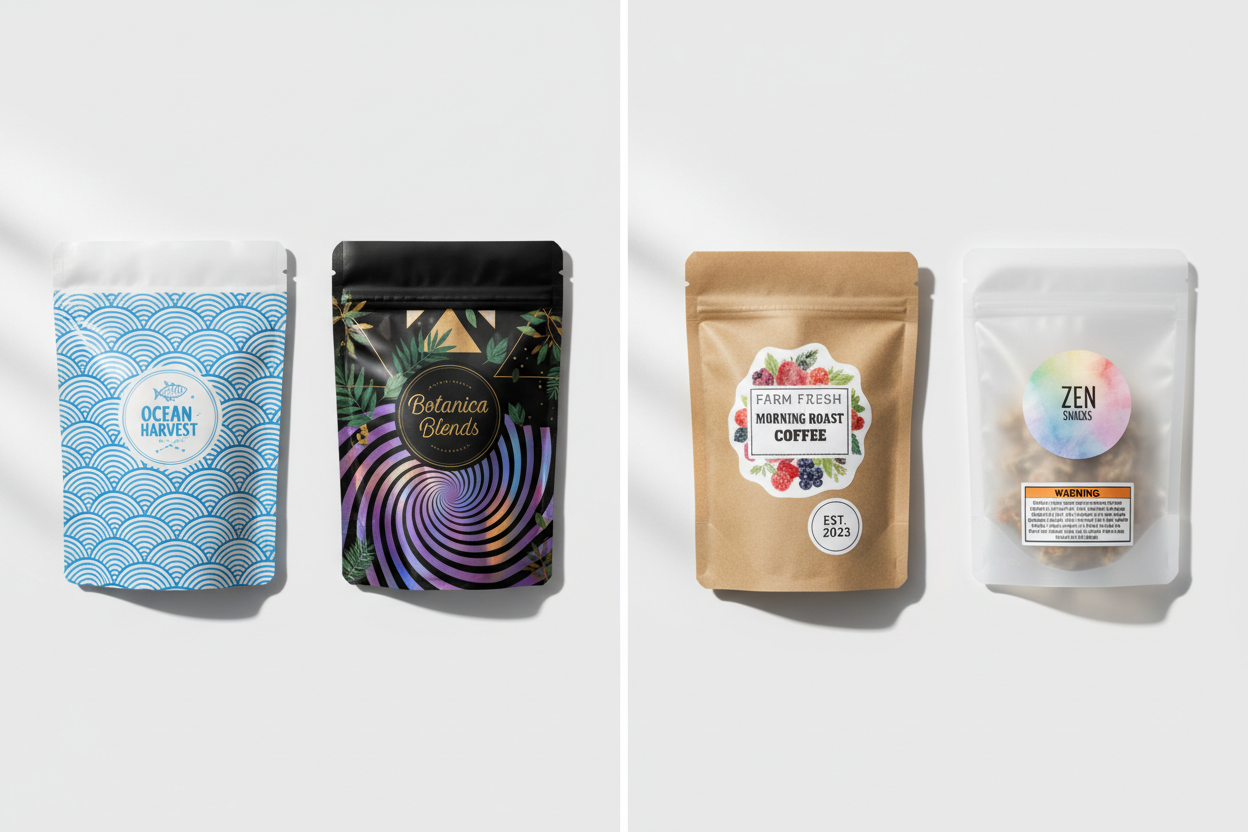
Printed packaging or stickers? After 11 years in the industry, I have an opinion on the matter.
Time, waste, recycling, and flexibility. Printing from 100 pieces, ready in 7 days.
Free shipping from £50. Stickers were a compromise.
A good compromise, and for a long time, the only one available - because printing was expensive, required large expenditures, and was reserved for large brands.
Small companies applied labels, and somehow it worked.
This has changed. Yet many companies still apply stickers - out of habit, because that's how it's always been, because they don't know there's another option.
We've been in the packaging industry for over eleven years.
We've seen hundreds of companies switch from stickers to printed packaging.
None has gone back. I explain why below.
Time - and this is the most surprising part.
Stickers don't stick themselves. Someone has to do it – evenly, precisely, each piece individually.
It's either the company owner (meaning time that should be invested in business development) or an employee (meaning an additional cost that rarely makes it into calculations).
And here's the problem – labelling involves time commitment.
Whether you sit and apply the labels or have an additional employee do it, someone has to do it.
And the printed packaging arrives ready. You insert the product, seal it, and ship it. Done.
One of our clients once calculated that his team spends about 40 minutes for every hundred pieces labeling.
That's several hours a week. Hours that don't go into sales, into the product, or into anything useful.
Waste – and one problem most people don't consider. Labels have silicone paper on the back.
Every label. This paper is garbage – it has to be stored, collected, and disposed of somewhere.
At scale, it really adds up. But there's a bigger problem with waste, which isn't talked about enough.
If you use recyclable paper packaging-and more and more companies are doing this-and put a plastic sticker on it, you automatically turn it into mixed waste.
Two different materials that can't be separated at the sorting plant.
What was supposed to be eco-friendly ends up in the trash along with everything else.
We see this regularly. Companies invest in biodegradable packaging because they care about the environment.
Then they slap on a plastic label. The intention was good, but the effect wasn't.
Printing on recyclable packaging remains recyclable. The printing is part of the material, not something added to the outside.
Flexibility-and here, printing has completely caught up with stickers.
Stickers have always been strong in one respect:
quick changeovers. A new flavour, a new date, a new design-you print different stickers, and you're done.
What I'm happy about is that printing has caught up with stickers in this regard.
Our minimum is 100-200 pieces. You can order 100 pieces of one flavour, 200 of another, 150 of a limited edition, all in a single production run.
A new series, a new date, a new colour-all possible at a production volume that makes sense for a small and medium-sized company.
We've produced printed packaging for weddings, birthdays, trade shows, and corporate events.
Small quantities, a specific design, and a professional effect.
Labelling in such quantities often results in an amateurish effect.
Printing doesn't. Consistency-and why it's more important than it seems. Hand-applied labels vary with each piece.
The first hundred come out great. By the third hundred, you get tired, the position shifts, and some look crooked.
In e-commerce, the main product photo is perfect-the label is straight, everything is in place.
The customer receives the package, and the label is two millimetres crooked.
This discrepancy between the photo and reality costs reviews.
When printed, each piece is identical. The first and the thousandth look the same.
What stops companies from switching? Usually one of two things.
The first is the assumption that minimum runs are high.
They used to be. Today, 100 pieces is the real entry threshold.
The second is what to do with the stock of standard packaging already in stock.
The quickest solution is usually to use what's available and switch to printing on the next order.
The cost of switching is quickly recouped. If you're not sure whether this makes sense for your volume and product, call or email us.
We'll give you a simple answer, including the fact that it might not be time yet.
Call: 02033719569
email: info@jamosolutions.co.uk
WhatsApp available